
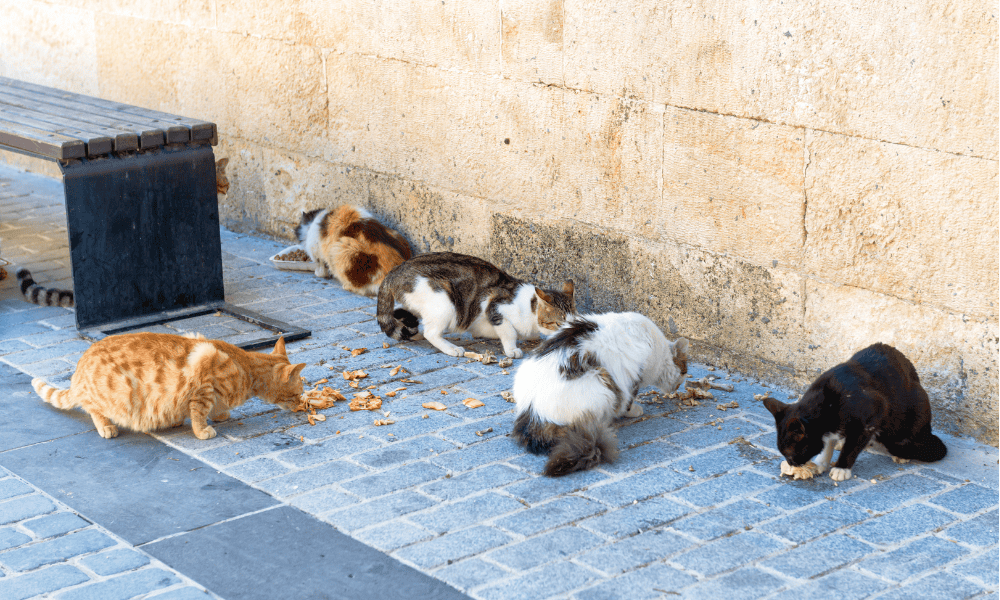
Dreamy sandy beaches, blue sea, and balmy summer evenings: the well-deserved holiday is, for most of us, the finest time of the year. Yet away from the hotel complexes and seafront promenades, a sobering reality awaits in many popular holiday destinations. Barely out of the hotel, you find yourself looking into the hungry eyes of an emaciated stray cat or crossing paths with a limping dog timidly searching for food.
In that moment, many animal lovers are instantly moved. The feeling of helplessness is overwhelming: Should I buy food? Should I simply ignore the animal? Will the hotel have a problem with it? The good news is: you don’t have to look away. There are ways you can make a real, lasting difference for these animals – both on the spot and even after you’ve returned home. In this blog post, we’ll show you exactly how. Janine and I (Alice) will also share our own experiences from our travels.
The Dilemma in Paradise: When Holidays and Animal Welfare Collide
Whether in Greece, Spain, Italy, or on popular holiday islands – the sight of stray animals is, sadly, a part of everyday life in many regions of southern Europe and beyond. For tourists, this often creates an emotional tug-of-war: you want to enjoy your free time, yet you find yourself confronted with the acute suffering of animals.
Why Is the Problem of Stray Animals So Widespread?
The scale of stray animal populations in many holiday destinations has various deep-rooted causes:
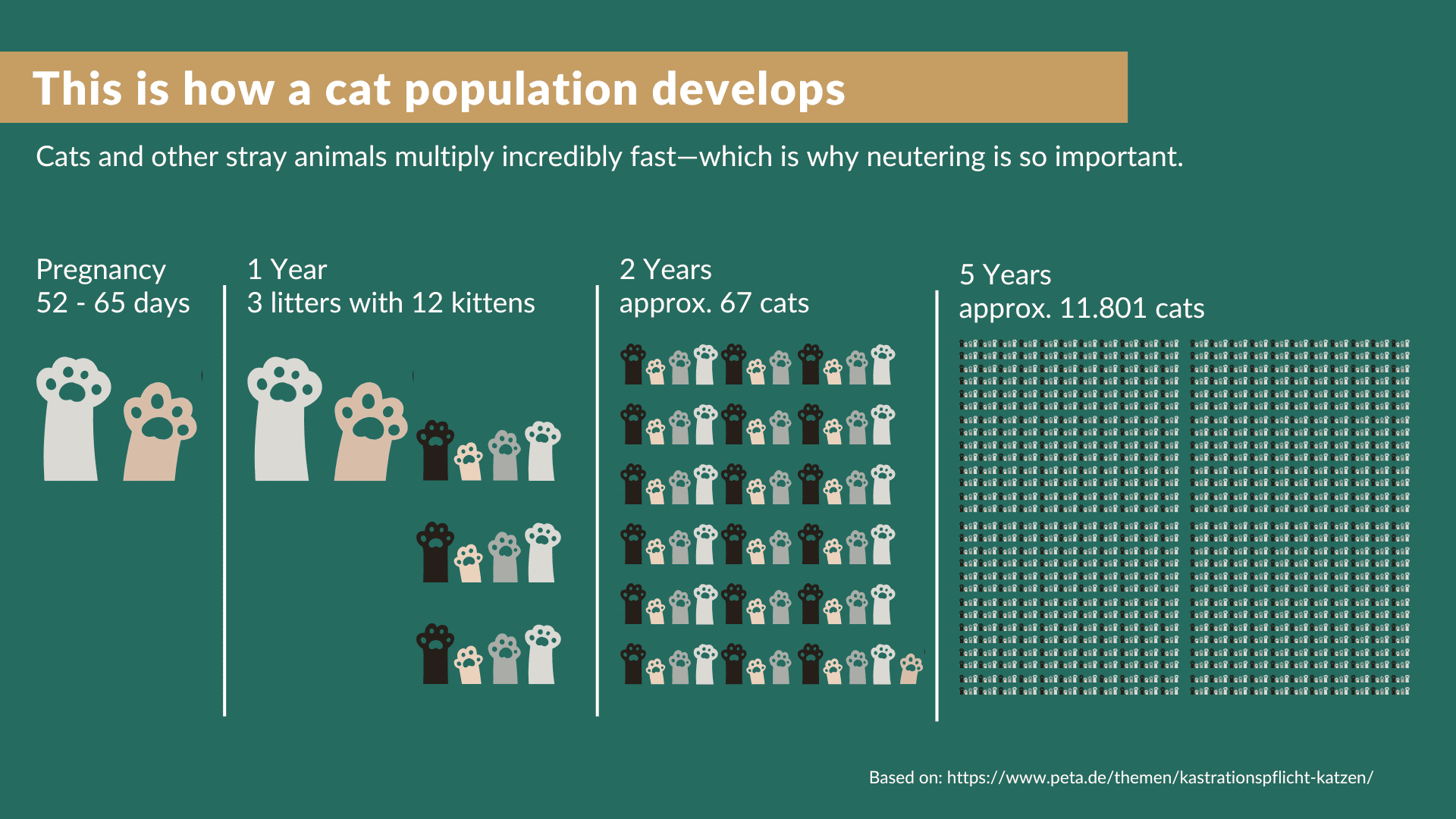
- Lack of neutering: The main cause of suffering is uncontrolled reproduction. A single unneutered pair of cats or dogs can produce hundreds of offspring within just a few years.
- A different attitude towards animals: In many rural regions abroad, animals are often kept not as family members but purely as working animals (e.g. for hunting mice or as guard dogs). When they fall ill, grow old, or are no longer needed, they are frequently left to fend for themselves.
- The tourist season cycle: During summer, well-meaning holidaymakers provide the animals with restaurant scraps and affection. Survival seems assured. But when the off-season arrives in autumn and tourists head home, the animals are left hungry, uncared for, and vulnerable.
Alice’s Story: Stray Cats in Madeira
How quickly you can go from holidaymaker to animal welfare advocate is something I experienced first-hand last year in Madeira. We had booked a beautiful place to stay on the rugged northern coast of the island – a quiet, idyllic spot with just a handful of houses, surrounded by banana plants and green vines. The accommodation came with a large covered outdoor area, and it was there that a surprise was waiting for us on our very first evening.
Two tortoiseshell cats came up to us and rubbed themselves against our legs. They were remarkably trusting and open. As someone who has adored cats since childhood, I naturally stroked them straight away (and then gave my hands a thorough wash afterwards). But looking more closely, the holiday joy quickly gave way to concern. While one cat was thin but seemed alright given the circumstances, the second was in a shocking state: her coat was matted and she was severely underweight.
A glance at the neighbourhood made things clear: apart from a few empty houses, there were only other holiday lets around. These two cats had no home – or rather, our covered outdoor area was their only home.
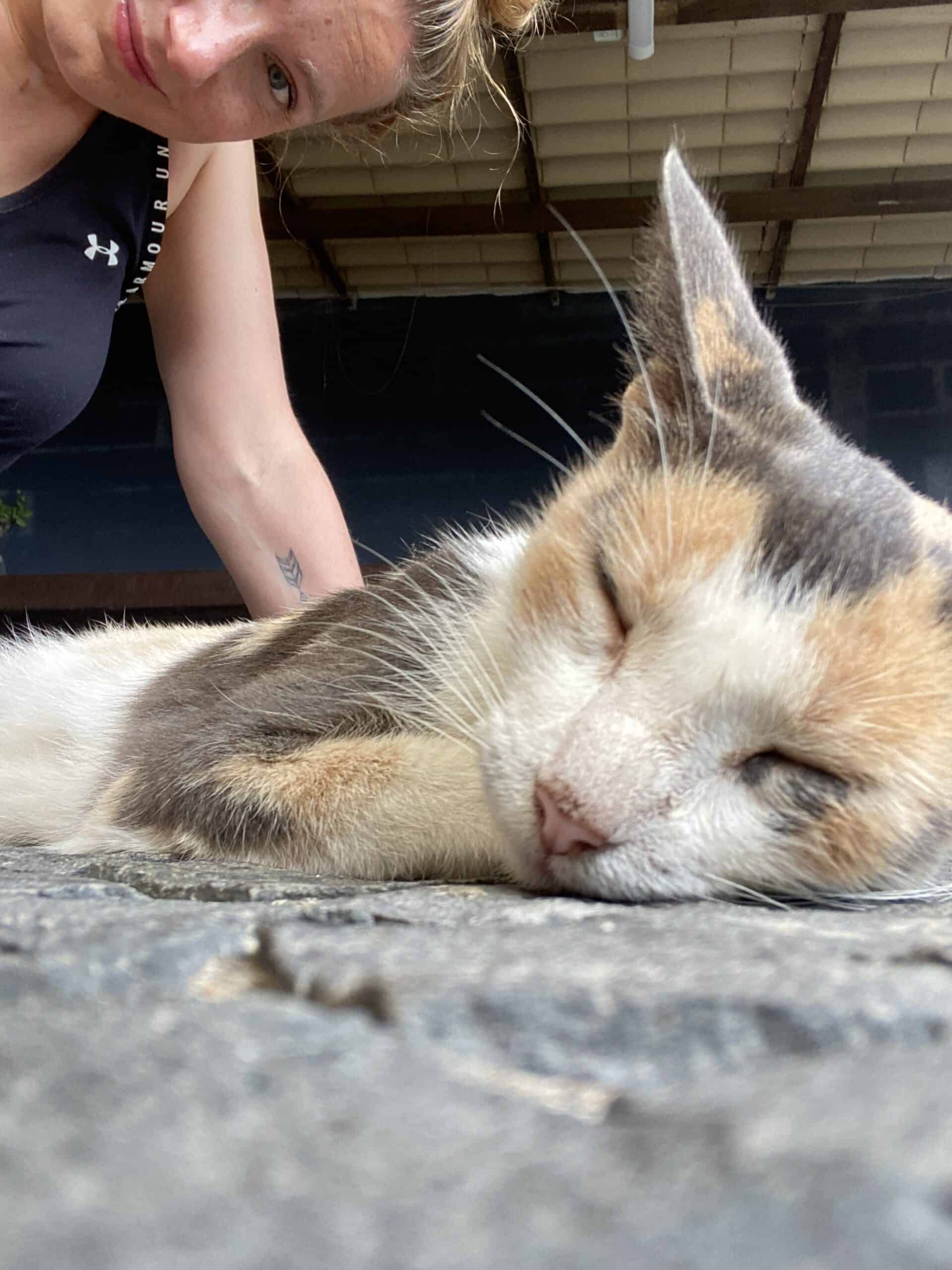
Looking away was not an option for me. I got out my phone, researched organisations in the area, and got in touch with a German animal welfare association that was active in Madeira. To my great relief, the response came quickly. The first piece of advice from the welfare workers: “Buy some food and feed them regularly so they stay in this spot and don’t wander off.” That was no problem at all, as the two were usually on the terrace the moment they heard our voices.
Over the following days, we arranged a meeting with a volunteer from the association. He came directly to our accommodation, carefully caught both cats, and took them to the vet. Our original plan – which we had also agreed with our landlady – had been: the cats would be given a check-up, neutered, and then returned to their territory near our holiday home.
At the vet, however, things took a different turn. The examination revealed that one of the cats was already pregnant. The other was so malnourished – despite the days we had been feeding her – that an operation would have been life-threatening. She first needed several days of medical care to build up her strength.
Because the two cats were so strongly bonded and understood each other instinctively, the association did not return them to the street after the clinic but placed them in a private foster home. And the best part: today, both cats have found a safe, loving, and permanent home. They will never again have to fight for survival on the streets or beg tourists for scraps.
This experience showed me: you are not powerless when you’re on holiday. But you do need to know how to act correctly.
Good Intentions vs. Good Practice: The Most Important Dos & Don’ts on the Ground
My own experience in Madeira shows just how wonderful a happy ending can be. But it also shows: animal welfare abroad requires a strategy. When we encounter strays on holiday, we tend to act on pure emotion. Many people don’t realise that well-meant gestures can inadvertently cause harm to the animals.
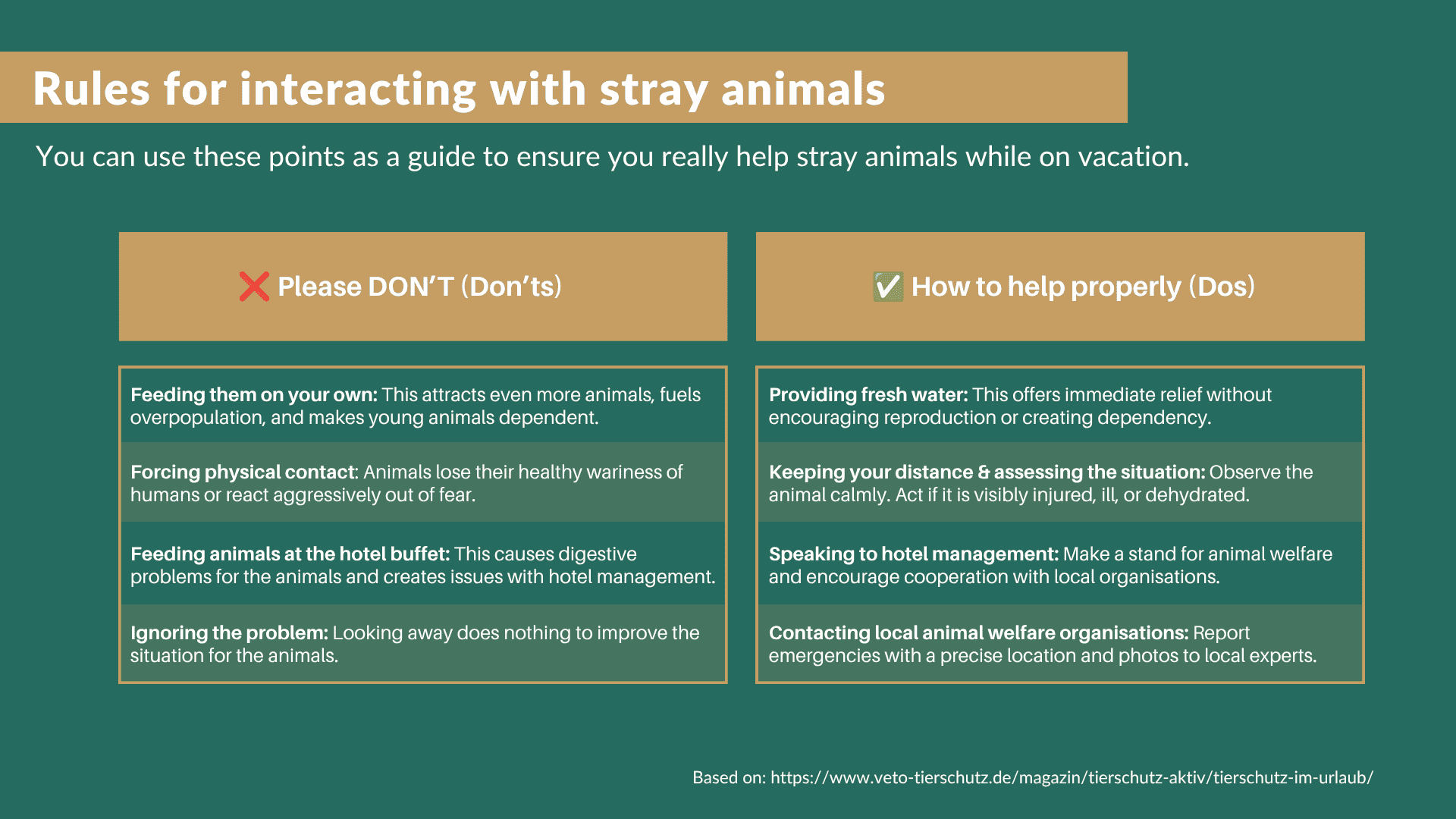
So that your help actually makes a difference, here are the key rules for dealing with stray animals.
Why You Should Avoid Feeding Strays on Holiday on Your Own
It might sound paradoxical: there’s a hungry animal right in front of you, and yet you’re not supposed to feed it? The German Animal Welfare Association (Deutscher Tierschutzbund) and experienced welfare organisations warn against independent feeding for good reason:
- Overpopulation is fuelled: A sudden, uncontrolled supply of food signals to unneutered animals that conditions are ideal for breeding. The result: even more puppies and kittens are born into a life of misery.
- Dependency and helplessness: Young animals fed by tourists never learn to search for food independently. When you leave at the end of your holiday and the season ends, the animals are left defenceless and without any survival strategy.
- Legal consequences: In some countries and cities (e.g. parts of Italy or Spain), feeding stray animals in public spaces is a civil offence that can result in significant fines.
Tip: If you want to do something good for the animals while you’re there, provide fresh water instead. Particularly during the hot summer months, extreme drought is common in many holiday regions. Just make sure not to place the bowls directly in front of hotels or restaurants, to avoid causing trouble for the animals. You can find more on the topic of resource scarcity in our article on water shortages whilst travelling: Info and three tips.
First Aid on Holiday: How to Report Emergencies to Local Organisations Correctly
So when should you step in? Precisely when an animal clearly needs urgent help: when it is injured, visibly ill, severely malnourished, or dehydrated.
- Check for an owner: First, try to establish whether the animal might actually have a home. Speak to local residents, passers-by, or shopkeepers in the immediate vicinity. The animal often belongs to someone but is free to roam.
- Contact local organisations: If no owner can be found, get in touch with local animal welfare organisations. Pro tip: ideally, note down the contact details of organisations in your holiday region before you travel. That way, you won’t lose precious time in an emergency.
- Provide precise information: Animal welfare workers rely on information from holidaymakers. Send the organisation the exact location (ideally via Google Maps pin), describe the animal, and attach photos. This makes locating the animal much easier.
Hotel Management and Online Reviews as Levers for Animal Welfare
Strays often turn up directly on the hotel grounds or during dinner on the outdoor terrace. Rather than secretly feeding them scraps from the buffet – which leads to severe digestive upset in the animals and trouble with the staff – you should speak directly to hotel management.
Calmly explain to the staff that the animals’ welfare matters to you and that you would like the hotel to take responsibility. There are already some wonderful pioneers in southern Europe: a number of hotels work closely with local organisations, set up supervised cat feeding stations away from guests, and fund neutering programmes.
Make your voice heard after your holiday too: praise animal-friendly initiatives in your online reviews, or calmly criticise any disrespectful treatment of strays. The tourism industry is highly sensitive to guest feedback. Awareness-raising and economic pressure are powerful tools in animal welfare.
Getting Involved on Holiday: Janine’s Experience at an Animal Shelter
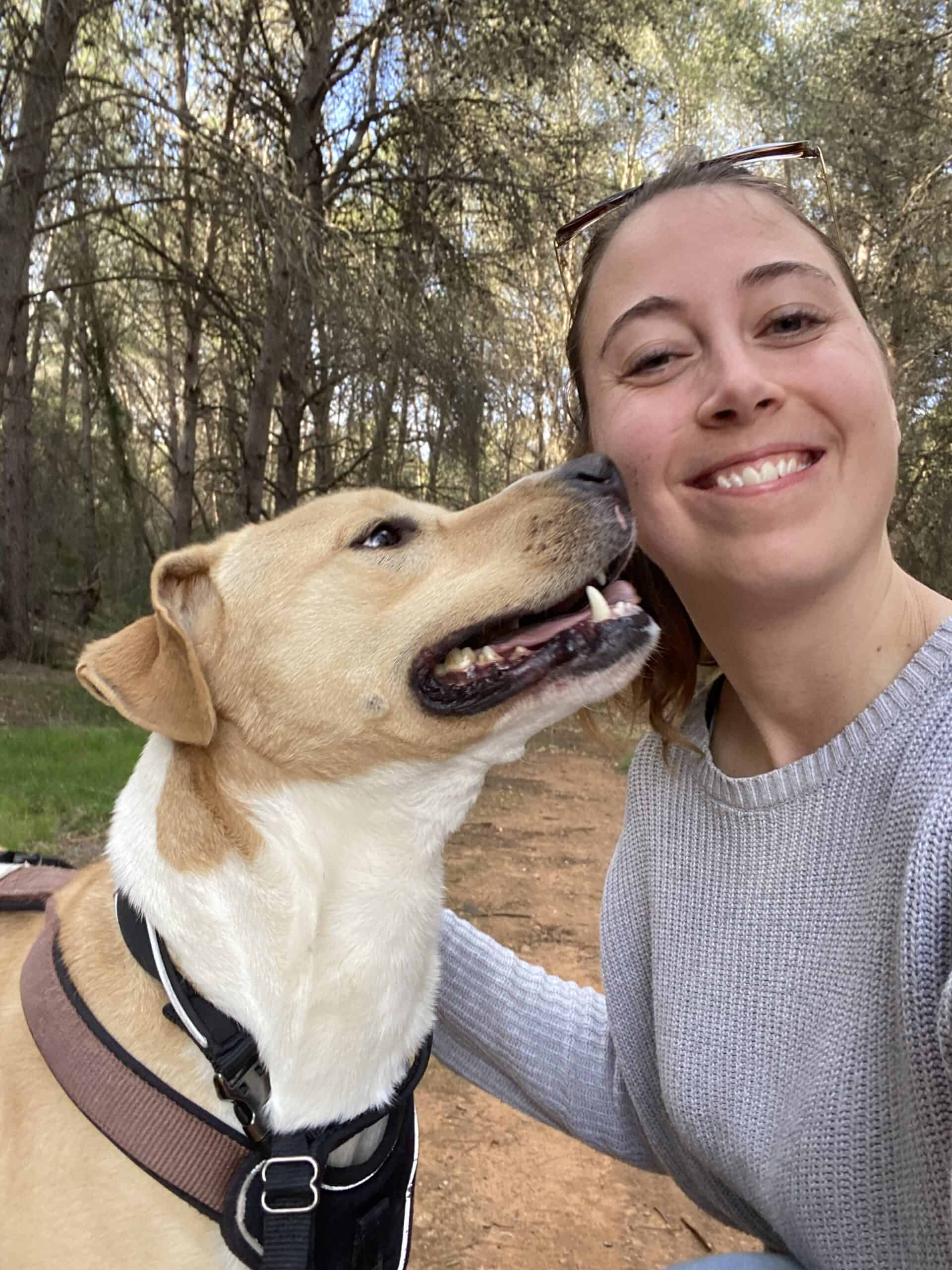
For those who don’t just want to stand by and watch but want to roll up their sleeves whilst on holiday, volunteering – working as a volunteer on the ground – is a wonderful option. That’s exactly the path Janine chose. She decided not to spend her entire holiday in Spain on the beach, but to give some of her time to a local animal shelter.
Her main tasks there were as simple as they were valuable: walking the shelter dogs, feeding the animals, cleaning and maintaining the kennels and cages, and of course spending time with the dogs and cats – playing with them and giving them the attention they craved.
In the chronically overstretched and understaffed shelters abroad, local volunteers simply don’t have the time to give every single animal the attention and exercise it urgently needs. Many dogs spend days or even weeks confined to their kennels. When holidaymakers like Janine step in to take the dogs for walks, it means pure quality of life, mental stimulation, and vital socialisation for the animals. For the local organisations, every helping hand is an enormous relief.
Pitching In Rather Than Looking Away: How to Support Local Animal Shelters Abroad
If you’d like to follow Janine’s example and help out at a shelter whilst on holiday, there are a few things to bear in mind:
- Get in touch early: Contact the shelter a few weeks before your trip if possible. Spontaneous visits can disrupt the tightly scheduled shelter routine.
- Manage your expectations: Alongside dog walks and cuddle sessions, hard work is often part of the deal too – like cleaning kennels or sorting food donations. Every task helps!
- Take responsibility: Even if it’s “only” a holiday stint, the welfare workers are counting on your reliability during that time.
- Donations in kind and financial contributions always help: Every shelter is grateful for donations. If you’d like to donate items such as food, leads, baskets, or blankets, it’s best to check with the shelter beforehand what is actually needed right now. That way you can help in a targeted way and your donation goes exactly where it’s needed most.
The Journey to a New Home: Become a Flight Guardian for Stray Animals
Alongside on-the-ground support, there is another incredibly effective way to help with animal welfare abroad – a concept that many travellers have surprisingly never heard of, despite being one of the most important tools available to welfare organisations: flight guardianship.
Many dogs and cats abroad have hit the jackpot and found a loving home or foster place in countries such as Germany, Austria, or Switzerland. The problem: the animals can’t travel alone on the plane, and long overland journeys are often stressful, expensive, or logistically near-impossible.
What Is Flight Guardianship and How Does It Work?
As a flight guardian (or flight courier), you essentially offer an animal welfare organisation the “space” on your already-booked return flight. The animal travels officially as your additional piece of luggage – either in a carrier bag in the aircraft cabin or in a secure box in the climate-controlled hold.
The most important thing first: there are absolutely no costs or bureaucratic hassle for you! The animal welfare organisation covers all fees for the animal, applies for the EU pet passport, arranges all necessary vaccinations, and handles the complete registration with the airline.
Where Are Flight Guardians Needed? How to Find Organisations in Advance
Whether an organisation at your holiday destination is currently looking for flight guardians is easy to find out from home, even before you travel. Simply enter the combination “flight guardian + [your destination]” or “flight guardianship + [your destination]” into Google.
A great many organisations have set up dedicated information pages explaining exactly which flights and airlines they need support for. Here are a few examples for popular holiday regions where flight guardianship plays a huge role:
- Madeira: The organisation ANIMA Tierschutz e.V. regularly seeks flight guardians for the Portuguese island.
- Sardinia: On the Italian island, the organisation proTier e.V., amongst others, is active and relies on flight couriers.
- Mallorca: For Germans’ favourite island, SOS Animal Mallorca, for example, is looking for support.
- Greece (Thessaloniki): Anyone flying back from the Greek mainland can check out the page of Griechische Fellnasen e.V.
- Cyprus: On Cyprus, the A.I.R.S. Foundation coordinates the air transport of rescued animals.
Step by Step: How to Become a Flight Guardian
The process is completely straightforward for you as a holidaymaker and can be broken down into four simple steps:
- Register before your trip: Once you know you’re flying to a typical holiday destination, search online for animal welfare organisations active there. Register with them, providing your flight details (date, flight number, airline, and destination airport).
- The airport check-in on arrival: A small pro tip that will save you any nerves: when you land at your holiday destination, take five minutes to have a look around. Find out where the check-in desks and the oversized baggage counter are for your return flight. That way, on the day you leave, you’ll know exactly where to go.
- The day of departure: On the day of your return flight, you meet up with a volunteer from the organisation at the airport. They bring the animal in a secure transport box, have all the paperwork ready, and check the animal in together with you.
- Arrival back home: After landing, you simply collect the animal from the special baggage desk (small animals in the cabin will already be with you). As soon as you leave the customs area and enter the arrivals hall, you will usually be eagerly awaited: the new owners or the German foster home will take the animal from you.
With this minimal extra effort at the airport, you literally become a bridge to a new life for a rescued animal.
Doing Good from Afar: One-Off and Regular Donations
Not everyone has the time whilst on holiday to muck in at a shelter like Janine, or flies with an airline that transports animals for flight guardianship. But that doesn’t mean you have to watch the problem helplessly. The most flexible and sustainable way to help street animals is through financial support for local organisations.
Animal welfare organisations abroad are funded almost exclusively through private donations. Every penny goes directly towards the animals’ survival:
- Immediate care: With one-off donations, organisations fund food, safe shelter, and often very costly veterinary treatment for injured or sick strays.
- Lasting change: Regular donations (e.g. through a monthly sponsorship for a specific animal or the organisation) give welfare workers the financial security to plan ahead. Only then can they fund long-term neutering projects to tackle the problem of overpopulation at its root.
A donation is also a wonderful way to give something back to your holiday destination. If you have enjoyed a country, its culture, and its nature, a donation to a local organisation leaves a lasting, positive footprint. Even the equivalent of one or two cocktails at the beach bar can be life-saving for a stray cat or dog.
Conclusion: Every Action Counts – Your Guide for Your Next Holiday
The sight of stray animals on holiday can be painful, but we are not helpless in the face of their suffering. Whether through the right behaviour on the ground – as we’ve seen in the dos and don’ts – through active involvement at a shelter like Janine, or as a future flight guardian: it is within our power to make paradise just a little bit better for everyone.
On your next holiday, don’t look away. Prepare briefly beforehand, save the important contact details, and travel with the reassuring feeling that you can make a real difference.

Alice
Alice studied business administration and worked for an agency in Cologne for three years. At the beginning of 2022, she decided to pursue a new career path with a focus on sustainability. She loves to travel and dreams of swimming with humpback whales in the Pacific Ocean.

Wer steckt hinter give & grow?
Job gekündigt, Welt bereist und auf einer Mission internationales Volunteering und Reisen zu revolutionieren. Kathrin ist Kopf und Herz von give & grow. Die gesamte Geschichte und was dahinter steckt kannst du hier nachlesen.
Denn auf Augenhöhe zu reisen verändert alles.
#reshapetravel
Du willst sinnvoll helfen und nachhaltig reisen?
Lerne in unseren Online Kursen wie du nachhaltig reisen kannst.