
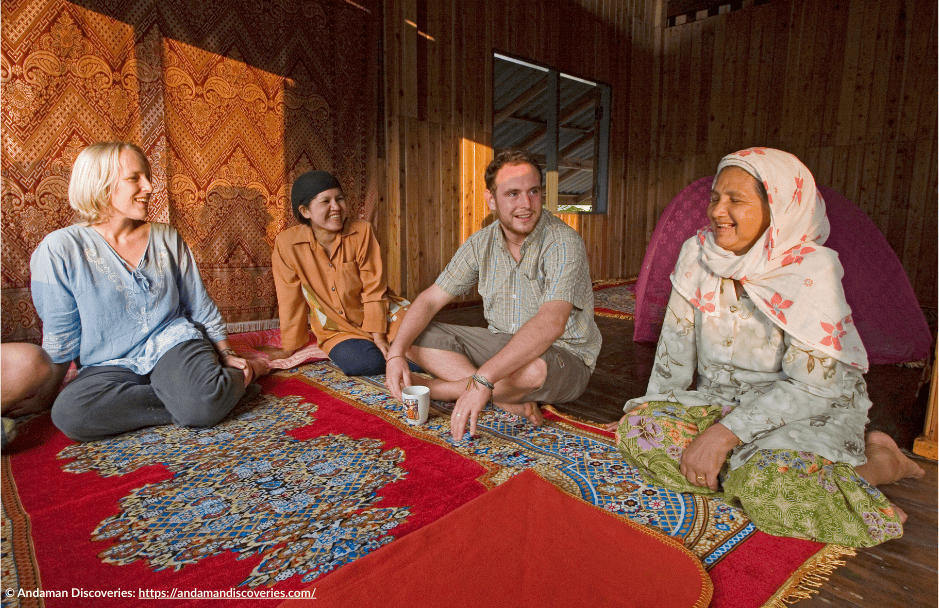
The way we travel determines who benefits from tourism – and who loses out. In many destinations, a large proportion of the revenue goes to international chains and providers, while local people have little say – and earn little. The consequences are clear to see: rising living costs for locals, cultural alienation, pressure on nature and habitats.
There is another way. Community-based tourism (CBT) is a clear alternative: here, local communities shape tourism themselves: they determine how many guests come, which activities make sense, how revenues are distributed – and how they benefit the community. For travellers, this means a closer, more authentic and more peaceful experience. For hosts, it means greater participation and a reliable income – without having to put their own way of life on show.
In this article, I explain briefly and clearly what CBT is and why it offers a fair alternative to mass tourism. I then show where it is already working well and introduce you to two specific places from my own travels.
What exactly is community-based tourism?
CBT is tourism that is planned and operated where it takes place: in villages, neighbourhoods and landscapes of the hosts. The community decides on offers, rules and prices, takes responsibility for quality and uses part of the income for projects that benefit everyone (e.g. water points, infrastructure, school materials). It is also important to note what CBT is not: it is not a stage for cultural performances, nor is it growth at any price.
The UNWTO (UN World Tourism Organisation) defines community-based tourism as: “A form of tourism development in which the local community is at the centre of tourism planning, development and management. CBT aims to improve the
quality of life of residents by optimising local economic benefits, protecting the natural and
cultural environment and providing visitors with high-quality experiences.” 1
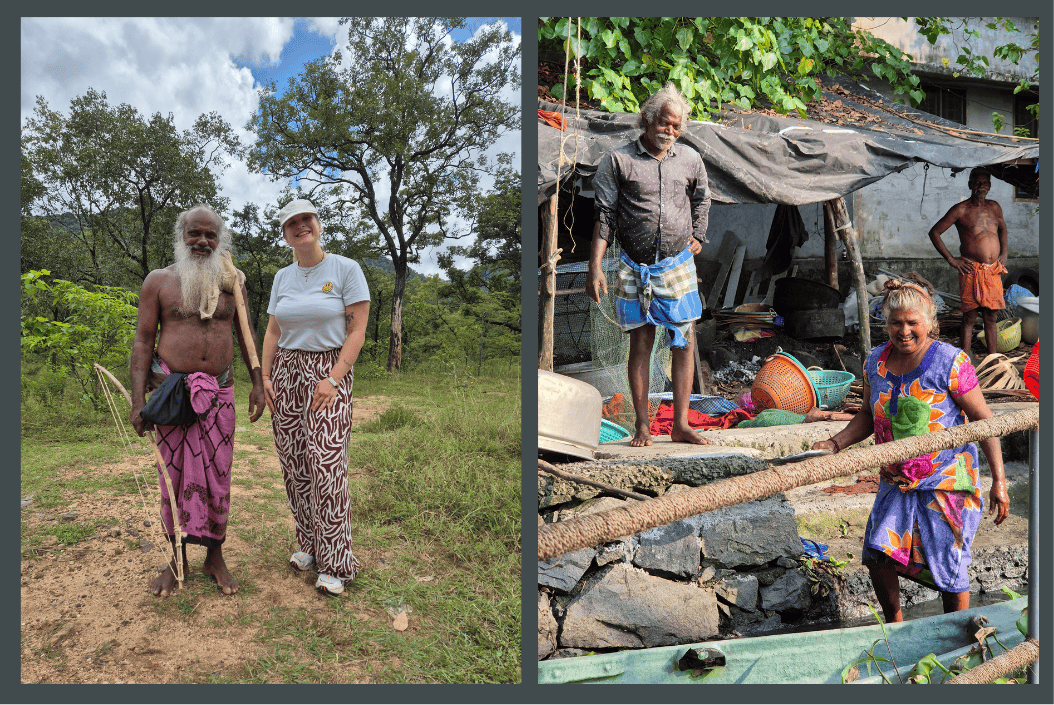
Left image: © Private Isabel Gruß | Right image: © Private Isabel Gruß
Why CBT is a fair alternative – the three pillars
1) Economy: Money that stays in the area
Tourism is a huge economic factor, but in many countries most of the money ends up in the hands of a few large companies. The difference is particularly evident in countries where tourism is the main source of income.
In Zanzibar, for example, tourism accounts for 27 per cent of GDP (gross domestic product). Many people work in this field. At the same time, a large proportion of tourism revenues flows to international companies – hotels, large tour operators, cruise ships. The local population benefits little, and the poverty rate is not really falling. 2
Community-based tourism shortens the money trail. What I pay for accommodation, food, guiding or transport goes to the people who host me, cook for me, guide me or own a boat. This generates additional income in the village, work for craftsmen and farmers, and a cushion for small investments (e.g. repairs, materials, joint funds). At the same time, it reduces dependence on jobs far away in tourist centres.
Community-based tourism ensures that:
- Smaller businesses and start-ups benefit
- Jobs are created – not only in the service sector, but also in skilled trades, transport and agriculture
- People in communities have a sustainable source of income – independent of mass tourism
- Infrastructure, schools and social projects are co-financed

Left image: © Private Isabel Gruß | Right image: © Private Isabel Gruß
2) Environmental protection and nature conservation
Did you know that nature suffers from mass tourism in many places? One example is Maya Bay in Thailand, which was overrun by tourists for years – the coral reef collapsed and the beach became uninhabitable. It took three years of closure for nature to recover. 3, 4 & 5
Community-based tourism often means less resource consumption and more sustainability. Community-based tourism usually takes place in rural areas, somewhat off the beaten track. This means that tourism is spread more evenly across the country instead of overloading individual hotspots.
CBT offerings are usually small-scale and resource-efficient – on foot, by boat, by bike, in manageable groups. When mangroves, rice fields, forests or karst landscapes are the basis of income, there is greater motivation to care for them: paths are maintained, sensitive areas are protected, rules are communicated jointly. Nature is not a backdrop, but a means of subsistence.
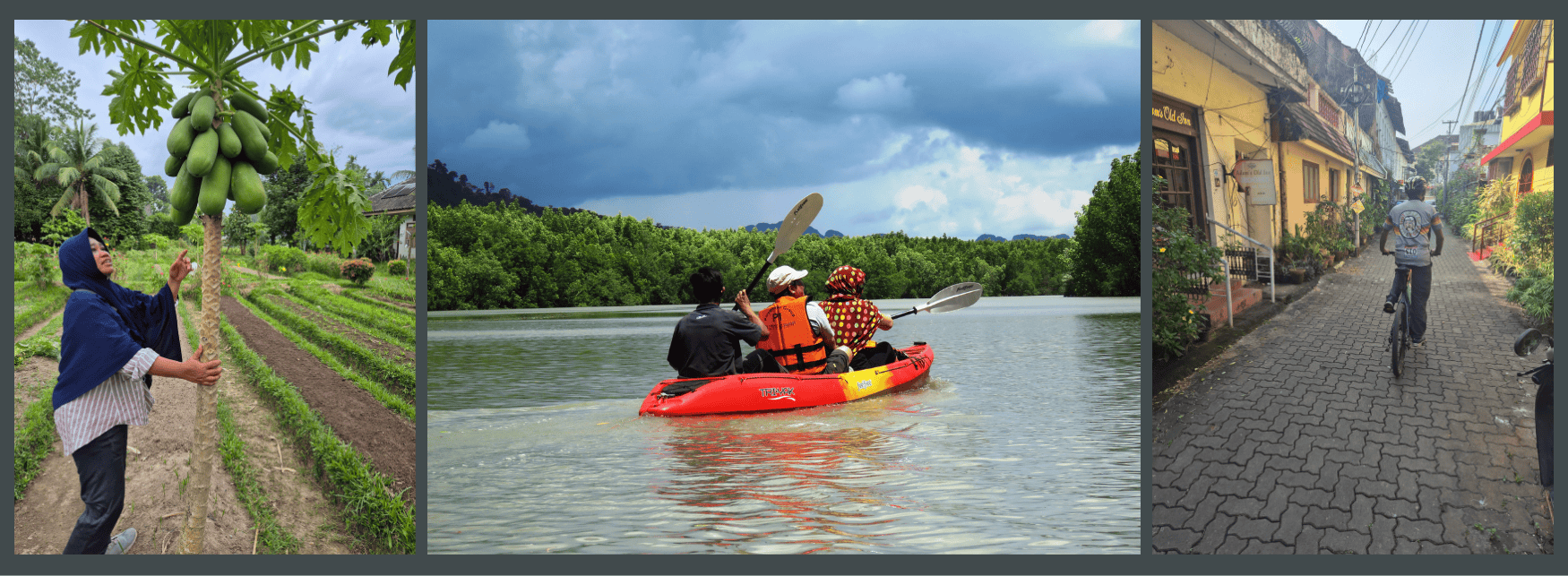
Left image: © Private Isabel Gruß | Image on the middle: © Company Andaman Discoveries | Right image: © Private Isabel Gruß
3) Culture & Togetherness: Everyday Life Instead of Performance
Community-based tourism means living culture: cooking in the family kitchen, crafts on the farm, field work, village routines. The community decides what is shared and what remains private.
It’s not about staged dance shows. This results in encounters on equal terms – asking questions, listening, participating. This strengthens respect and understanding on both sides and leaves memories that go beyond the photo at the hotspot.
Why are these encounters so special and valuable? Because they are genuine. A conversation with a villager, cooking together or a spontaneous invitation to a local festival – these are encounters and experiences that go deeper than any sightseeing tour. You experience the culture from the perspective of the people who live it.
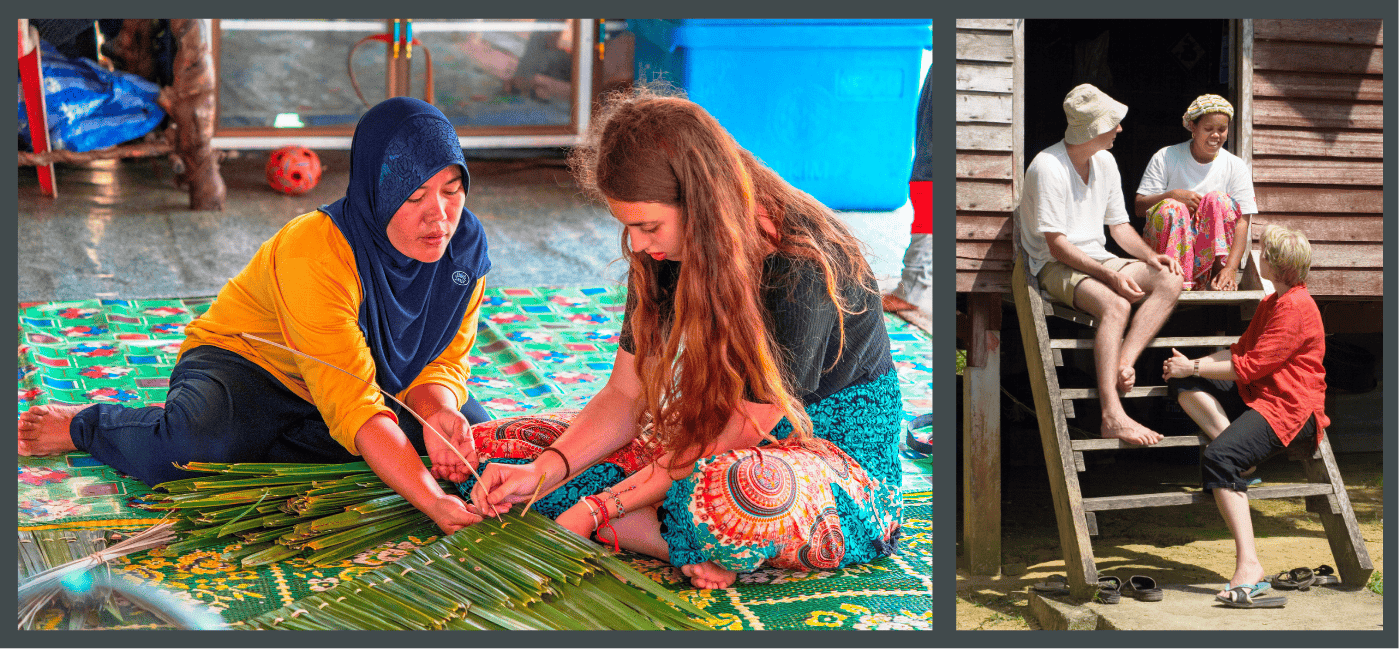
Left image: © Company Andaman Discoveries | Right image: © Company Andaman Discoveries
Community-based tourism – two examples where it is already working well
In Thailand, many villages operate with clear village rules and quality standards. In India – especially in Kerala – village experiences are intertwined with women’s cooperatives and agriculture. Indonesia promotes so-called ‘Desa Wisata’, tourism villages that are gradually developing their offerings. Nepal is a homestay* pioneer with village routes, host rules and seasonal management. What all of these have in common is small units, transparent distribution and clear boundaries.
* Additional information: A homestay is an opportunity to stay with a local family and get to know the everyday life, culture and living environment of the local people up close. You usually rent a room in your host’s home and participate in family life.
From my own travels, I would now like to introduce you to two places that show what CBT feels like in everyday life – and why it works.
Example 1: Muungoni Village (Zanzibar)
The situation in Zanzibar
When we google ‘Zanzibar,’ we get images of powder-white beaches, swaying palm leaves and luxurious resorts by the turquoise blue sea. And yes, these places really do exist. But they are only part of the story.
Zanzibar is more than just an Instagram hotspot. Tourism is heavily concentrated on the coast. Many resorts are owned by external operators, and a large proportion of the money spent goes back to supply chains outside the villages. For locals, this often means jobs far from home, little say in decisions and a noticeable increase in the cost of living in beach regions.
What makes Muungoni different
Muungoni is located in the south of Unguja between the main island and Uzi. Surrounded by dense mangrove forests and far away from tourist centres such as Paje or Nungwi, it is well hidden in the jungle. Perfect for anyone who wants to get to know the authentic Zanzibar.
Here, income is distributed within the village community: families cook for guests, women sell handicrafts and demonstrate techniques, local guides lead tours through the village and mangroves, and boat builders and drivers earn money from the tours. Part of the income goes towards things that the village specifically needs, such as school supplies or the maintenance of communal buildings.
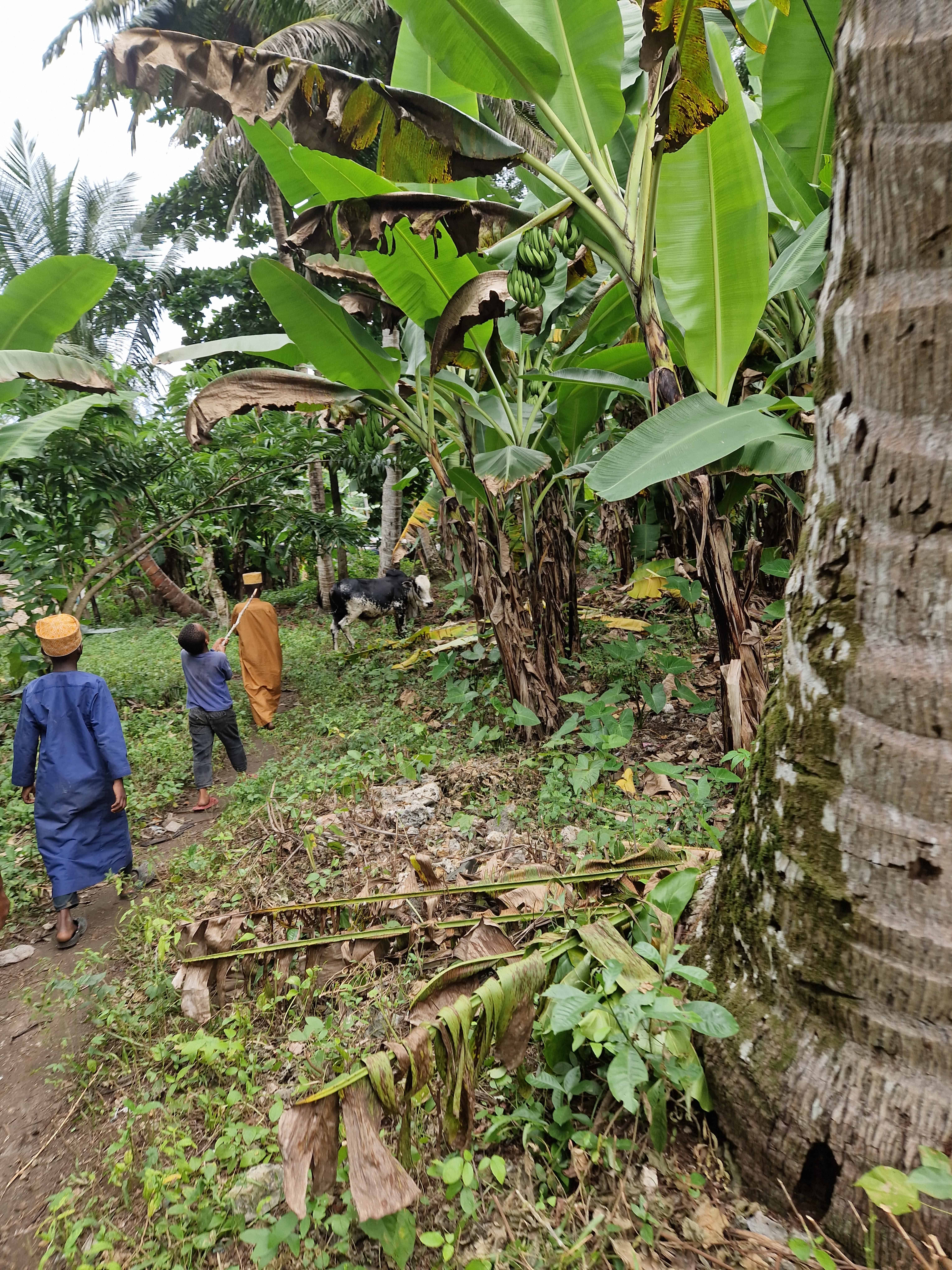
Image: © Private Isabel Gruß
What to expect – Village and Mongroventour
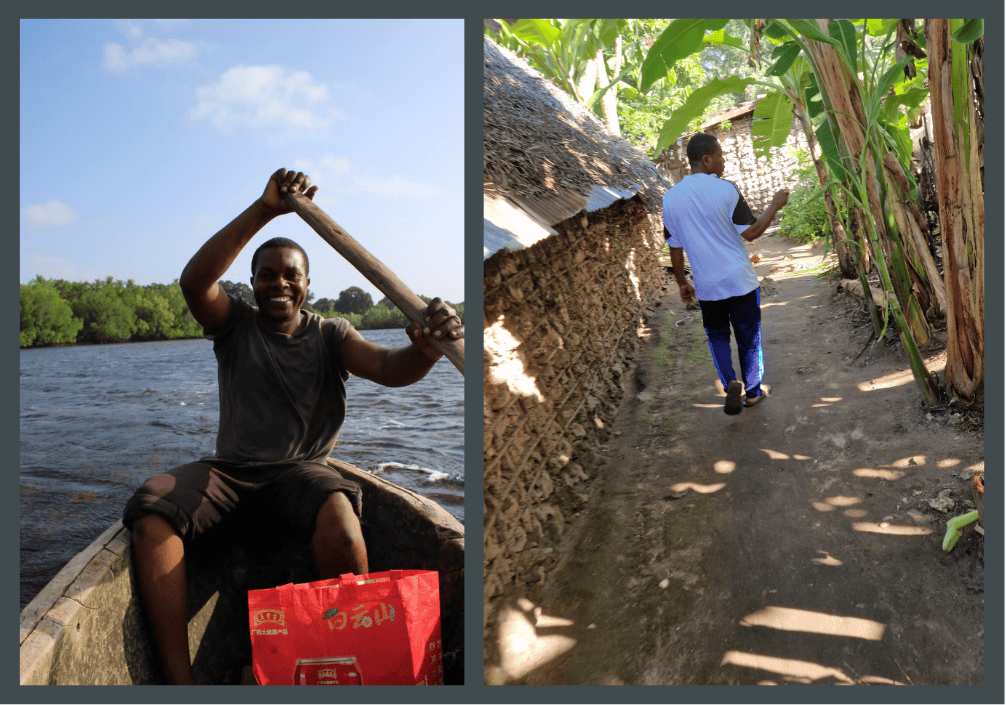
Ramadan is a local guide from the village. He took me into his family and accompanied me through the village, the mangroves and the jungle for several days. He explained to me how the traditional mud houses are built with palm fronds and coral stone.
We visited a villager who showed me Khanga dresses. Depending on the occasion, the women wear different colours and patterns – for weddings, funerals or everyday life. I was allowed to try on a few myself. On the tour, we met two other women who showed me how coconut palm fronds are processed and how food is traditionally prepared in the village.
Left image: © Private Isabel Gruß | Right image: © Private Isabel Gruß
After touring the village, we ventured deeper into the jungle. Ramadan explained the medicinal plants growing along the path, which are used by local healers. Finally, we reached the mangroves – an ecologically incredibly valuable area.
At sunset, we climbed into a traditional wooden canoe and paddled through the interwoven waterways. Ramadan handed me a fresh coconut. A moment that will remain in my memory.
Back at the house, Ramadan’s wife had already prepared dinner. We all sat on the floor and enjoyed a traditional Swahili meal – fish, plantains, rice, fresh vegetables. There was no table, no chairs, but plenty of warmth and community. I slept in a small room next door that used to be available for guests.

Left image: © Private Isabel Gruß | Right image: © Privatee Isabel Gruß
Example 2: Rammang Rammang (South Sulawesi, Indonesia)
The location – Jurassic Park feeling
What makes this place special is the density of the karst towers: steep, overgrown rocks stand so close together that small valleys, caves and short gorges are formed between them.
In the morning, ground fog often lies in the fields, during the day the rock faces are reflected in the calm water of the canals, and small caves with stalactites and cool air open up in the edges of the rocks. A truly magical place. It is also referred to as the ‘Halong Bay’ of Indonesia, only much less crowded.

Left image: © Private Isabel Gruß | Image in the middle: © Private Isabel Gruß | Right image: © Private Isabel Gruß
How community-based tourism is practised here
The accommodation structure consists solely of homestays run by families. Nasrul was one of the first and remains the first point of contact for neighbours and travellers alike. The community is unanimous: no large hotels. Boats belong to local families, small entrance fees for trails and caves go towards maintenance, warungs cater to guests, and guides lead tours to caves.
The villagers have often demonstrated against the government to prevent the creation of a mass tourist region here. And that’s what makes this place so special. You immerse yourself deeply in the life and everyday routine of the people here and experience nature up close.
I was able to spend three days here and explored the area with Nasrul and other travellers. A landscape from another time. We took a boat to deserted areas, experienced magical sunsets, made our way through ancient cave systems and learned a lot about the local flora and fauna.

Images: © Private Isabel Gruß
Conclusion: Travel fairly, stay close to home
Community-based tourism is not an extra, but a different logic of travel: money, decisions and responsibility remain in the local area. Muungoni and Rammang Rammang show what this results in: small, harmonious offers; clear agreements; encounters that do not seem staged – and places that remain peaceful and lively as a result.
For this to work, it takes little glamour, but good basics: transparency in distribution, limits on visitor numbers and time – on both sides. As a traveller, you can also contribute: respect local rules, ask where your money is going, and take enough time to really arrive.
In short, CBT makes travel fairer, slower and more meaningful. When choosing your next destination, look for proximity to the community – then ‘away from the crowds’ will not just be a promise, but a lived reality.
Looking for authentic travel experiences?
Village Adventures is a social start-up and the first travel platform for authentic travel experiences with a focus on community-based tourism (CBT). Here you will find accommodation and activities/tours for trips that immerse you in the local culture.
Sources / Further information:
MDPI Artikel: Community-Based Tourism: A Catalyst for Achieving the United Nations Sustainable Development Goals One and Eight https://www.mdpi.com/2673-5768/6/1/29?
Research Gate: Enhancing Educational Strategies for Sustainable Tourism in the Geopark Area: A Case Study Geopark Maros Pangkep: https://www.researchgate.net/publication/382481160_Enhancing_Educational_Strategies_for_Sustainable_Tourism_in_the_Geopark_Area_A_Case_Study_Geopark_Maros_Pangkep
GSTC: Nepal’s Community Homestay Network
https://www.gstc.org/nepals-community-homestay-network/
GSTC: The Criteria for Thailand’s Community-Based Tourism Development is now a GSTC-Recognized Standard: https://www.gstc.org/the-criteria-for-thailands-community-based-tourism-development-is-now-a-gstc-recognized-standard/
UNESCO: Maros Pangkep UNESCO Global Geopark: https://www.unesco.org/en/iggp/geoparks/maros-pangkep
emerald Insight: Leakages in the tourism systems: case of Zanzibar: https://www.emerald.com/tr/article-abstract/68/1/62/379779/Leakages-in-the-tourism-systems-case-of-Zanzibar

Isabel
Hi, I’m Isabel. Passionate traveller, adventurer and founder of Village Adventures, a travel platform focusing on community-based and rural tourism away from the usual hotspots. I create authentic encounters with locals – with accommodation, day trips and multi-day trips. The mission: away from mass tourism – towards genuine encounters.
Incidentally, my idea for Village Adventures was born in Zanzibar in 2023, when I spent time with Ramadan in Muungoni Village. There, I understood how much power there is in genuine, authentic encounters – and what influence we have as travellers. Since then, I have been specifically looking for initiatives and stories that touch people – and for ways in which we can make travel fairer and more meaningful.

Wer steckt hinter give & grow?
Job gekündigt, Welt bereist und auf einer Mission internationales Volunteering und Reisen zu revolutionieren. Kathrin ist Kopf und Herz von give & grow. Die gesamte Geschichte und was dahinter steckt kannst du hier nachlesen.
Denn auf Augenhöhe zu reisen verändert alles.
#reshapetravel
Du willst sinnvoll helfen und nachhaltig reisen?
Lerne in unseren Online Kursen wie du nachhaltig reisen kannst.